


Wondering what this is all about? Read the introduction here first.
Overview & Design Goals
Dojos are highly social communities replacing more traditional ‘Quick Play’ or ‘Social’ playlists. Each Dojo consists of approximately 500-1000 active players who are grouped together based on a brief survey about their personality traits & motivations. Borrowing from martial arts, players can earn colored Belts by completing Trials & improving both themselves and their Dojo.
The primary design goal for Dojos is to create a genuine sense of community while reducing the anonymity which invites toxicity and inhibits social engagement. To accomplish these goals, we borrow from the Server Browsers of yester-year by grouping players into small, persistent communities which naturally lend themselves toward repeat interaction between players.
How It Works
The journey begins a mysterious letter, beckoning the player to a remote setting at the top of a mountain where they are greeted by ‘The Guide’. They are asked a series of questions which help to determine the type of player they are before being ultimately introduced to a Dojo based on their selections (a bit like determining your ‘Harry Potter’ house).
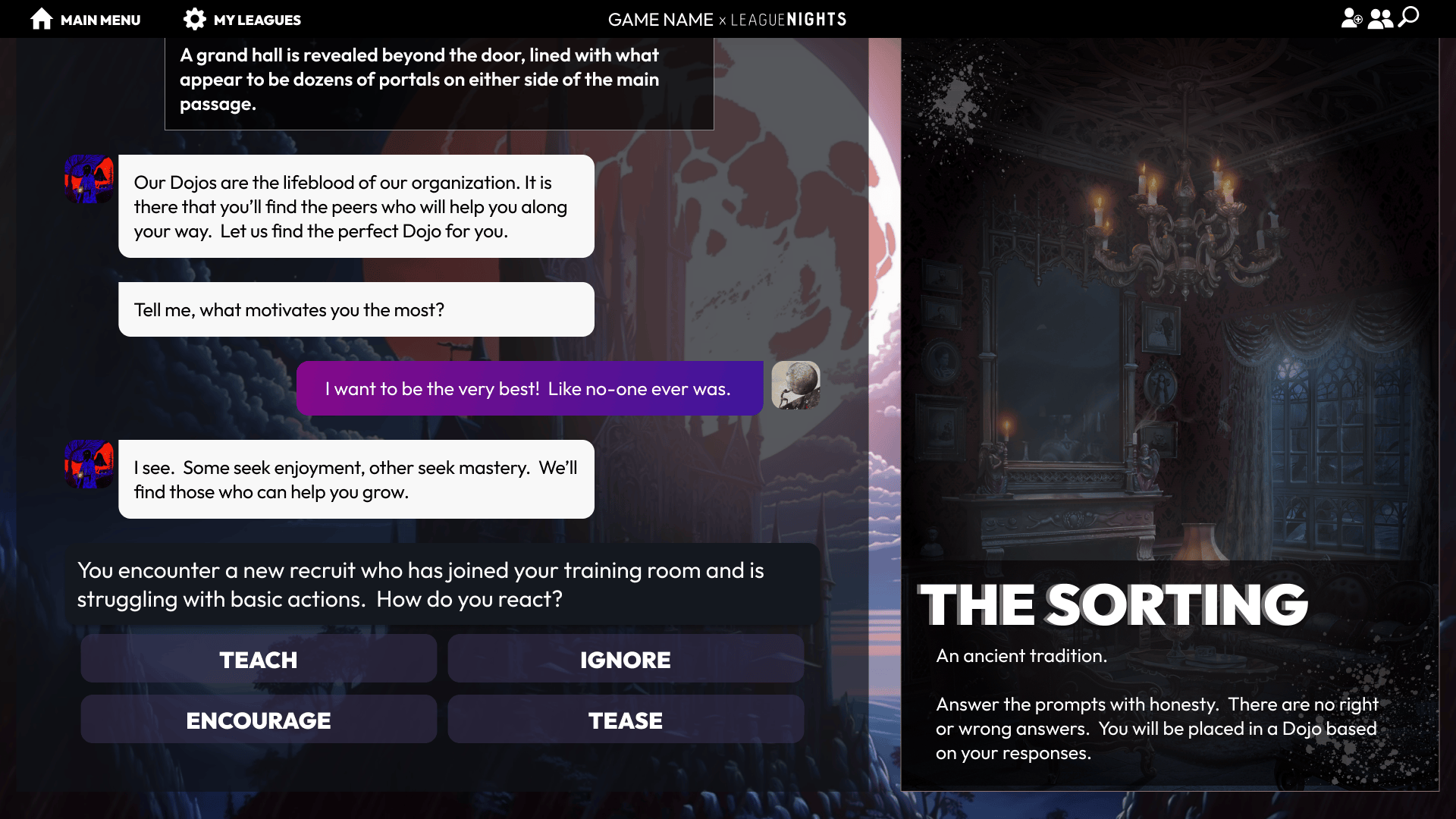
Each Dojo is comprised of ~500-1000 active players, a number which can swell or shift as new players join the game. Of course, as populations adjust it may become necessary to merge smaller Dojos or create new ones, but the goal is always to keep groups of players together as best as possible. Content creators who have particularly large communities may also opt to create their own Dojos provided there is enough interest.
In the Dojo Lobby, several ‘Recommended Rooms’ from your Dojo are displayed along with the list of players currently training in them. These recommendations will prioritize players who you have played with before, players you have played with before, and gameplay settings which you prefer to play most often. Players may also choose to select a room from a complete server browser, or opt to ‘travel’ to be able to play with a friend from another Dojo.

Dojo rooms provide a low pressure environment where players can kick back and hangout, practice, or get some warmup in before hopping into other more competitive modes. Gameplay in these servers keeps players together from match to match, balancing out teams between games and changing maps/modes based on player voting. Rewards incentivize players to remain in a server with a group of players rather than continually hopping around.
While in Dojo servers, players complete Trials to progress towards upgrading the colored belt which is worn on their Player Card. These Trials are a mix of unique challenges, long term objectives grinded out over time, and social/community goals which encourage players to form parties and attend events. Once all required Trials have been completed, players attend a weekend ‘Belt Ceremony’ and other players in their Dojo effectively grant them their next belt by giving them ‘Vouches’ during matches.
FEATURE HIGHLIGHT
‘HEAT’
To encourage players to remain in the server, players generate heat during gameplay by winning rounds, eliminating players of higher skill, communicating, or any other actions based on the game.
Heat continues to build during a session, and drops by 50% if the player opts to go to another server, or reset entirely at the end of the play session. Each week, the best sessions & biggest grinders are displayed on leaderboards in the Dojo Lobby.


FEATURE HIGHLIGHT
TRIALS & TRINKETS
Earning your next belt requires completing several Trials. Each belt features its own Trials, providing long-term goals for players to work towards. Trials also include objectives promoting interacting with other members, such as playing in a party with a newer player to serve as a mentor.
Limited Time Challenges provide new, difficult goals to be completed before they expire. Completing these will earn the player decorative ‘Trinkets’ which can be used to make their Dojo belt their own.
FEATURE HIGHLIGHT
PLAYER-CREATED ROOMS
Rooms are created by members of each Dojo as a perk which is earned by contributing to the Dojo in a variety of ways: playtime, completing trials, gifting others, serving as a mentor, etc.
Room creators are able to name it, select banner art, and define what settings, maps, or modes that Room uses.
The Dojo itself also features its own banner, color scheme, daily quote, and logo which are chosen by the current Dojo Master to make each community unique.

Design Corner
A Brief History of Matchmaking
It’s been quite awhile since the last meaningful shift in how players get into a multiplayer match.
Prior to modern matchmaking, games predominantly featured Server Browsers where players would select their server from a list. For many players this meant finding a community-ran server with settings & players you enjoyed hanging out with, and then making that server your home.

As communities grew in size, that server browser approach ran into some growing pains. Relying on the community to operate quality, well-ran servers for millions of players presents challenges for everyone involved. For new players, digging through a giant list of servers with highly varied settings is a very daunting experience, and even veteran players would find themselves fighting for limited openings within the popular servers which they called home.
In the early 2000’s Microsoft introduced and popularized the ‘Matchmaking Playlist’ concept which became the standard for Xbox Live, the Xbox 360, and gaming as a whole. No more digging through massive lists of servers to find a place to play – the new matchmaking system was incredibly streamlined and gave developers control over who players were matched with. This helped to bridge some pretty major accessibility gaps which the server browser approach had exposed.

As an industry, we’ve now spent nearly 20 years perfecting that system. Time spent waiting for a match has been greatly reduced, larger populations have allowed for more effective skill matching, and a tidal-wave of data analytics has allowed designers to fine-tune the algorithms to optimize for player retention.
And yet players continually voice their frustration with these systems and the resulting matches.
It would require a much longer article for me to break down the goals of game developers and the gripes which players have in a way that does both sides justice. It’s an incredibly complicated system with a lot of nuance depending on the features of each game involved. So instead I wanted to approach the problem from the top down:
As designers, our focus on skill-matching and fair, balanced matches is a case of spinning our tires against the wrong design goal.
In the process of removing every bit of friction from the matchmaking process, we’ve lost the social ‘glue’ which made the experience worthwhile in the first place. Players are entirely interchangeable to a point where we’ve literally started replacing them with bots in order to optimize the matchmaking algorithms even further. The human element is increasingly being lost, and this is creating an incredibly over-engineered single player experience for many of our players. These games are becoming less and less of a place to hang out and make new friendships, which is the entire value statement of a multiplayer game.
Pro-Social Matchmaking
Enter Pro-Social Matchmaking and 【PROTOTYPE】, which borrows from that community-forming Server Browser approach of early multiplayer. Grouping players into communities of ~500-1000 active players allows players to gain familiarity with one another while still being large enough that at least one server will be running during the early hours when population is at its lowest.

In the Dojo design, we utilize a wide range of account data (the Dojo questionnaire, account history, previous sessions, etc.) to present several ‘Recommended’ Rooms rather than showing the entire server browser. These servers will prioritize players who you’ve played with recently, and are selected from your Dojo community of 500-1000 players; so there’s already a likelihood of at least some level of familiarity with the other players in the server.
Both server browsers and small communities are great for building a sense of companionship between players. Toxicity is much less commonplace when you will play with a player again in the future, or you share a common affiliation (such as a guild, clan, or dojo) with one another. Even simply having seen a username a few times is a great first step towards being friendly with someone.
This sense of belonging is a huge emphasis here. When you ‘know’ the people you’re playing with, you’re more likely to want to come back again in the future. You’ll associate positive feelings with time spent in that space. You might even make a new friend.
Making Quick Play/Social Play More Approachable
Because the intent of this framework is that it applied to nearly any multiplayer game, 【PROTOTYPE】 doesn’t really delve deeply into gameplay. However, I did want to briefly talk about the importance of keeping players together from match to match when possible.
Modern multiplayer games take different approaches here, but it’s relatively common for matchmaking to be handled the same between Quick Play and Ranked Mode: Players select matchmaking playlist, the game creates a fresh match, the match completes, and all players are dumped back into the main menu to matchmake again.
This approach makes interaction with other players nearly impossible. Of course, you could reach out to teammates from the previous match and invite them to your party – and some games certainly offer features which make that a little easier. But in practice, this design is telling the players that everyone is expendable and replaceable. We’ll find you a brand new set of faceless players in a jiffy.

There’s an unintended consequence here as well: we’re telling the players that we’ve crafted a balanced and fair multiplayer match for you, and that winning is the primary purpose of the mode.
The offshoot of that is that even Quick Play/Social Play, which is meant to be a laid back environment, suddenly becomes a bit more competitive and intense. Players are less likely to experiment, do goofy shit, or prioritize having a good time – and instead are more likely to become hostile or frustrated when another player ‘ruins’ a match by not trying their best.
This is backwards. Quick Play should be positioned as more of a hangout, free of consequence and home to endless shenanigans. It’s a place for players to try new things, kill an hour or an evening, and generally improve at the game before dipping their toes into other modes. But more than anything, it’s the best mode designers have available to create a low-pressure social environment to build trust and familiarity between our players.
This is best done by games which keep players together from match to match, fill out the room with join-in-progress, and then use a loose auto-balance to keep teams relatively fair. In the Dojo design, I’m reinforcing this with a score and bonus rewards for remaining in a server over time (‘Heat’, above).
Of course, this approach does require supporting gameplay design to work most effectively. You might consider a game like ‘League of Legends’ where join-in-progress doesn’t really work and a single quitter during a 25-30 minute match would basically wipe a server. It’s not a one-size-fits-all solution; but most games would benefit from consideration towards Quick Play modes which support a more laid back gameplay experience that can be a better foundation for social gameplay.
Social is Good for Business
For all the types of people this blog might reach, I’d imagine somewhere there’s a cynical Executive or Product Manager who has been reading this and thinking: ‘Building social bonds is nice and all, but our analytics department has shown me that our 24h, 7d, and 30d retention metrics are better than ever since we implemented our most recent skill-based matchmaking updates.’
This is one area which I’ll acknowledge is a bit of a well-informed ‘hunch’ and requires some experimentation, but to state a hypothesis:
Players are continually bombarded by new games, being pulled by their friends toward the next hot thing. It is games with communities which are tightly woven by powerful social bonds which can best withstand the hottest new release. Building those bonds requires leveraging Pro-Social Matchmaking, the most powerful tool in the live service toolkit, and succeeding would dwarf the incremental ~1% retention gains being chased with Skill-Based Matchmaking optimizations.
Stepping away from skill-based matchmaking as the default can be daunting, especially when any major studios has extensive data showcasing its effectiveness. And it is obvious that no player enjoys being consistently overwhelmed by better players, especially during their first few days of play. Addressing this concern is essential for any system, regardless of how deep in the weeds you want to get on creating ‘perfect’ matches versus simply breaking up losing streaks.
However, while losing has a proven negative effect on retention and engagement, playing in a group has been shown to boost it even more significantly. In fact, playing a game with others has such a positive influence that it often serves to mitigate the negative impacts of losing. Multiplayer games should be optimizing for this aspect above all else.
Yet, when games do focus on enhancing social engagement, it is often through the lens of attracting entire existing friend groups to all come play the game together. And while a pre-established friend group might lure you into trying a game initially, it it just as likely to lead you to another game a few short weeks later. This cycle is seen all the time with new releases experiencing sharp drops in both player count and party play within the first months.
On the other hand, a focus on creating a warm and inviting community ensures there’s always familiar faces awaiting you even when your friends move on to something new. That is the glue which holds a game together for the long haul and allows it to grow with each release, establishing the type of environment we strive to provide our players. It’s building up those newfound friendships and shared memories which makes multiplayer development rewarding.
NEXT UP:
ARENA
A series of live tournaments which players can enter into with our ranked currency ‘Coins’. Collect coins to earn entry into exclusive higher stakes events and compete on the leaderboards for end-of-season rewards.
