
Welcome to my strange little project.
This is somewhere between an elaborate profile piece, a game design, a business plan, and a pleading rant for a future where we build things which make everyone just a little less lonely. Consider this project to be a manifesting of the change I want to see in the games we build; taking the form of overly indulgent design project between jobs – the result of over 20 years spent almost exclusively playing and designing competitive games.
Enjoy the read, hopefully this is just the start of many conversations to come.
-Colin
My life has been shaped by multiplayer gaming. From the moment I first hopped online with our insanely slow dial-up internet when I was just 11 years old, I’ve sought out new competitive games to play and settled into the communities which sprung up around them. While learning and attempting to master a new game is always fun, it was the people who carried my involvement over the long haul. The ability to be a part of a community built around that shared (often niche) interest is something difficult to find in a local neighborhood.
Over the years, I’ve continually observed the unique ability that competition has to pull strangers together. There’s something in the alchemy of pursuing self-improvement alongside your peers which generates a shared empathy and understanding of one another. Your accomplishments – an awesome shot, a new personal best, your first ‘Top 64’ finish – become amplified so much more when they’re celebrated alongside people who were there for your journey.
It all leads to such an incredibly powerful social environment. I’ve been blessed with dozens of close, long-lasting friendships which began simply as strangers playing together late into the night.
Over time, developers of competitive games have been gradually eroding away at the features which most empower forging those friendships. Chat features have been disabled by default, match lobbies are shuffled and rearranged after every match, players are being replaced with deceptively named bots, Clan and Guild features have been removed entirely, and even ‘Ranked’ modes are increasingly being restricted to Solo play only. The intentions behind these shifts have been largely good, but the reason these games are so special has become increasingly out of focus with each iteration.
Matchmaking systems are the foundation of millions of friendships and childhood memories. We have a responsibility to provide more for our players than an endless stream of anonymous opponents.
What is 【PROTOTYPE】?
【PROTOTYPE】represents a fresh approach to competitive multiplayer design. Its primary purpose is to prompt discussion towards a world where developers prioritize (and players demand!) features promoting social bonds between players while embracing an approachable brand of recreational competition.

There are three primary features on display:
- DOJO – A replacement for ‘Quick Play’. Highly social practice environment built around communities of ~500-1000 active players. Complete social objectives to graduate to your next belt.
- ARENA – A replacement for ‘Ranked Mode’. A series of live tournaments which players can enter into with our ranked currency ‘Coins’. Collect coins to earn entry into exclusive higher stakes events and compete on the leaderboards for end-of-season rewards.
- LEAGUES – Engaging team-based mode, built around ‘League Night’; a weekly community event which places teams into recreational leagues to progress their campaign from week to week.
These features are designed to be entirely game agnostic – they may be applied to any game which has winners and losers.
These systems can be implemented comfortably for everything from traditional Team vs Team shooters, Battle Royales, and even asynchronous speed-running competitions with only minor updates to competition formats.
Skill-Based Matchmaking is Failing Players
Nearly 20 years ago, Xbox Live implemented and popularized the concept of a matchmaking ‘playlist’ in Halo 2 and other Xbox multiplayer titles. As this approach was adopted across the industry, it represented a major paradigm shift. Rather than players selecting their favorite community server from a list, Skill-Based MatchMaking (SBMM) would prioritize pairing players of similar skill into a match together.
Since its inception, there has been a continual back and forth between players complaining about matchmaking and developers tinkering with the increasingly complex algorithms which drive it. Vast mountains worth of data have been digested in order to build intelligent models to better measure player skill and predict match outcomes. And for the most part, it has been successful in improving match quality.
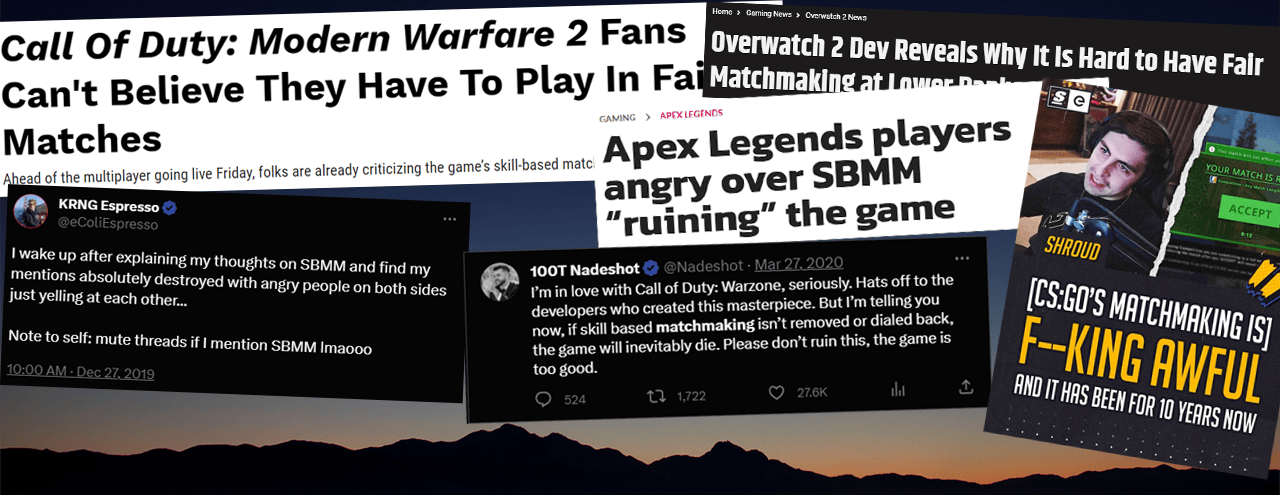
However, despite data indicating historically fairer matches, player complaints about matchmaking are as prevalent as ever. There are a lot of reasons for this, many of which I covered in a previous blog, but it’s also fair to suggest that the old adage “I’m only happy when I’m winning” is a primary culprit here. Players are going to lose inevitably, and any system which focuses solely on creating fair matches is going to fall short on making players happy.
When our current matchmaking approach fails to satisfy players after decades of refinement, we are long overdue for a re-evaluation. What if, instead of pursuing fairness, we used these powerful tools to create a more fun, social experience focused on making losing less frustrating?
What is Pro-Social Matchmaking?
Pro-Social Matchmaking (PSMM) focuses on connecting players who will want to play with each other, prioritizing compatibility over strict skill parity. Player skill certainly remains relevant, but other factors take precedent; such as “How much does this player care about winning?”, “Do I recognize this person from previous matches?”, and “Does this person like to use voice chat?”.
Matchmaking in this manner borrows heavily from dating apps and Discord servers around shared interests, with the aim of building more localized communities of players who recognize each other. Rather than an endless stream of anonymous opponents, we focus on repeat interactions to foster familiarity and begin to build social bonds between players. A persistent server filled with familiar faces becomes more ‘Chill Hangout‘ and less ‘Thunderdome‘, and losing becomes much less painful.
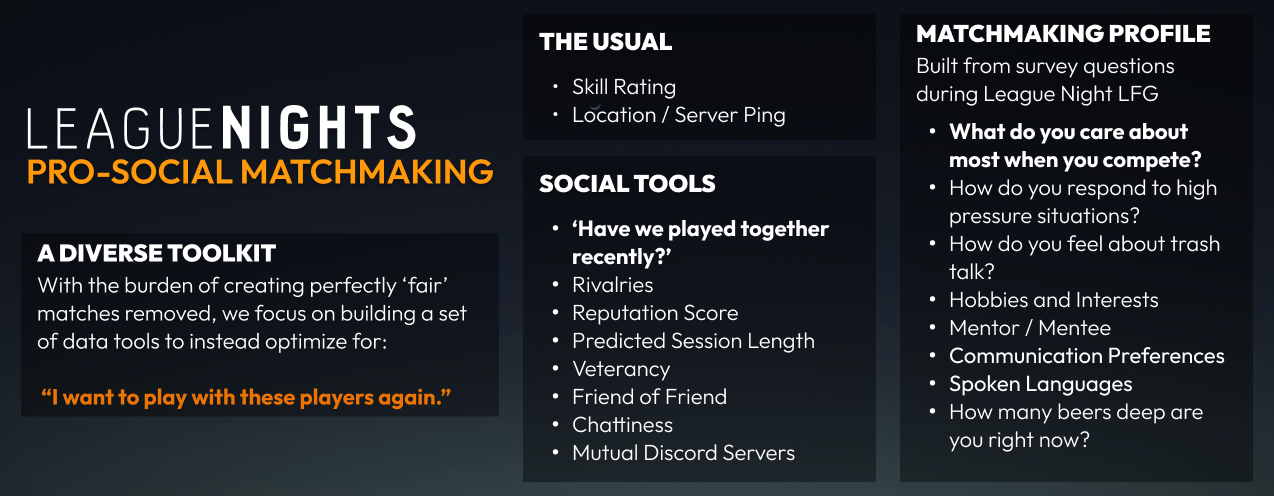
With more data points to match players, we’re also able to choose the right tools for the job based on the activity. We can leaning on skill when necessary for competition, while being able to use a more social indicator like ‘favorite hobbies‘ to find teammates which are worth hanging out with in a call for several hours during a League Night. This is an incredibly powerful tool for converting a group of strangers into a welcoming environment which leaves players looking forward to playing together again in the future..
Recreational Competition, Highly Personalized
Skill-Based Matchmaking algorithms do still have purpose here. Rather than using SBMM to attempt to create the perfect multiplayer match,【PROTOTYPE】uses existing skill algorithms to provide player with personalized goals based on their ability.
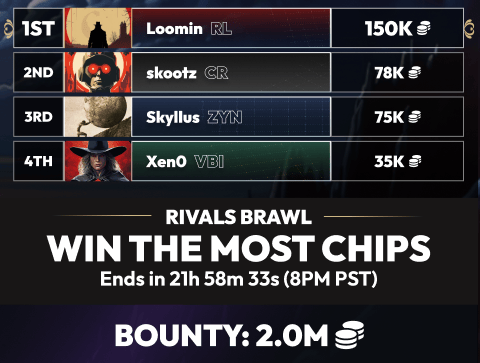

In the ranked Arena mode, each week players are given ‘Rivals’ of a similar skill and activity level. Defeating your Rivals by earning more points over the course of the week can provide bonus rewards. Additionally, when players enter Arena tournaments they’ll be provided with a ‘Beat the Algorithm’ challenge which prompts them to place higher than the matchmaking algorithm expects them to finish.
These personalized challenges lend from sports psychology, utilizing ‘Personal Bests’ and attainable, incremental goals to reward players as they push past expectations or have a particularly good week of play. This provides an immensely better emotional experience than the typical Ranked frustration of watching ELO/MMR ebb and flow as the drywall by your monitor collects fresh fist-sized holes with each loss.
Smaller Development Teams, Communities from Zero to Millions
It’s no secret that launching a new multiplayer game as an indie developer is a monumental undertaking full of pitfalls. Every year there’s a small graveyard of multiplayer games from studios of all sizes which fail before they even make it out of ‘Beta’. There’s a massive laundry list of required features for any game hoping to have a chance in a market full of other free-to-play options with years of built up features.
【PROTOTYPE】presents a framework which can be applied to any competitive multiplayer game. It provides an adaptable roadmap which scales for games with communities in the dozens all the way to the millions of daily active users, attempting to answer the ‘dead game‘ problems of launching with a small community while iterating and improving your designs early in development.
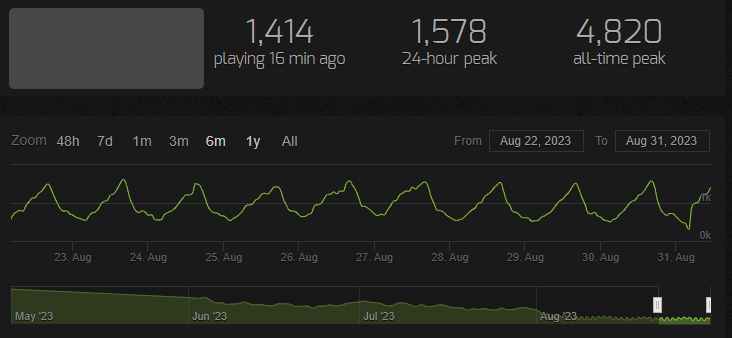
It’s no secret that multiplayer games become their best when they are given time to grow alongside a small, passionate communities early in development. Existing matchmaking paradigms make it incredibly difficult to grow a community, creating a risky all-or-nothing approach which requires a game to find its audience immediately upon open beta launch and necessitates massive development teams to be ready for that moonshot. 【PROTOTYPE】would enable very small development teams to reach players much quicker, even converting early Alpha playtests into engaging live tournaments with rewards to begin organic community growth from Day 1.
About ‘League Nights’
‘League Nights’ was founded by myself – Colin Fogle. I’m a former professional gamer turned Game Designer who has worked in various capacities on franchises such as Fortnite, DOOM, Halo, and more. I designed and helped develop the Fortnite Battle Royale in-game tournament system which operated the 2019 Fortnite World Cup and its online qualifiers which hosted over 40M unique competitors and awarded over $100M to players.
‘League Nights’ represents a commitment to pushing the industry forward with features which promote positive social interactions. In an era where people are increasingly feeling isolated and lonely, games are the perfect bridge toward friendships which last lifetimes and committed communities which are there for each one another.
How to Help
My goal is that this Pro-Social approach can find its way into your favorite games, games of the distant future, or perhaps even breath life into old favorites which never got their moment to shine.
Here’s how you can help:
- Players: If you find yourself dreaming of these features for your favorite games, please simply help by following on social media and sharing this around. Shifting the industry often requires showing that players want something new, and every tweet, clip, or follower we can point towards to help the case is helpful.
- Creators: If you’d like to chat I’m more than happy to jump in a stream, podcast, video; whatever. I’ve been in the industry for 12 years and have worked on Fortnite, Paragon, Halo, Doom, Call of Duty, and even Farmville in various capacities. Also happy to share what it was like being a pro gamer in the late 2000’s.
- Developers: I’m looking to build a network of developers and industry people who share a passion for these areas and want to push the industry forward towards a more social competitive landscape. If you’re running a team creating a multiplayer game and this interests you; I’d also love to chat.
- Investors: Maybe you’ve got a dozen games in your portfolio all hiring backend engineers to build nearly identical systems, or maybe you’re equally bullish on the power of a more social-driven approach to competitive play. I’d like to make introductions.


